Net Art

The Wave Opus 1 transmediale.10

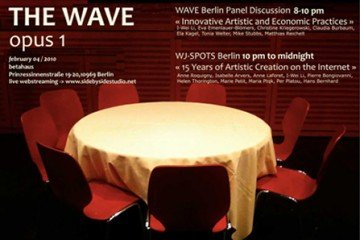
WAVE Berlin Panel Discussion. Fluctuations in the economy have become similar to global climate warnings : nobody knows exactly what will happen tomorrow, or whether the future will be bleak or bright. Uncertainty seems to become the only certain rule. Throughout the early 20th century, art was the forerunner of social, political and technological upheaval.... READ MORE...

Journalism Is A Process, Not A Product. An Interview With David Cohn From Spot.us

American Journalist, 27 years old, David Cohn started off as a freelance writing also for Wired, Seed Magazine, Columbia Journalism Preview. As editor at newassignment.net he took care of a project focused on citizen journalism. He organizes, on account of Buzzmachine.com, his first Networked Journalism Summit which had the purpose of gathering all the best practices and professionals of online journalism. He also worked for Broowaha, wide network of citizen journalism and now he works in Oakland, near San Francisco.... READ MORE...

Connectivism & Open Education. Education Of The Future

A property of one entity must lead to or become a property of another entity in order for them to be considered connected; the knowledge that results from such connections is connective knowledge'. This is the epistemological principle of connectivism about which George Siemens - connectivist theorist at the Manitoba University - talks about in his book titled Knowing Knowledge (Knowing Knowledge - George Siemens, 2006)... READ MORE...

Pixxelpoint 2009

Kulturni Dom Nova Gorica (Slovenia) is proud to announce the 10th edition of the International New Media Art Festival Pixxelpoint, that will open at the Mestna galerija Nova Gorica on December 4, 2009, at 8.00 PM. The festival will take place from December 4 to December 11, 2009, and will have two venues: the Mestna Galerija Nova Gorica, every day from 9.00 AM to 7.00 PM; and the Fondazione Cassa di Risparmio di Gorizia (Via Carducci 2, Gorizia), every day from 2.00 to 7.00 PM. ... READ MORE...

Jonah Brucker-cohen: New Media, From Web 2.0 To Web 4.0

Jonah Brucker-Cohen is a researcher, an artist and a writer who, in spite of his youth, has reached unquestionable fame and respect internationally in the field of new media and technologies applied to art. He has recently obtained a Ph d at the Disruptive Design Team of the Networking and Telecommunications Research Group (NTRG) at the prestigious Trinity College in Dublin.... READ MORE...

Distributed Creativity Models: The Crowdsourcing

It was maybe predictable and it is definitely significant: Creative Review's has included crowd-sourcing among the topics covered in their 'Year in Review' December issue. I haven't checked the magazine yet, but I am researching on digital creative crowd-sourcing models since a while and I think they represent such an interesting opportunity for creatives that we should celebrate here.... READ MORE...

Mediamatic Travel: Online Cultural Turism

The Mediamatic travel project, carried out by Mediamatic Bank, one of the most important cultural centers in Amsterdam and in Europe, is ready to turn the world of cultural tourism upside down. If you connect to the following website http://travel.mediamatic.net/, you can find an endless list of cities, spread all over the world, with which it is possible to interact following definitely innovative approaches.... READ MORE...

Competition: Art 2.0 Vocento

Open call for proposals by VOCENTO in collaboration with ARCOmadrid 2010 International Contemporary Art Fair, Madrid. VOCENTO and ARCOmadrid announce a competition of ideas to provide art galleries with web solutions, and to provide opportunities to enhance their online presence and networking potential.... READ MORE...

Plots In The Net: Boone Oakley And Web Storytellers

Once upon a time there was an internet site, an amount of web pages linked one another and housed in a clearly identifiable space which could be reached by a precise address. Once upon a time there was also the html - which later changed into xhtml - the language behind the hypertext system that can organize and make information intelligible, mainly in pictures and texts, of which web pages are composed. Yes, once upon a time.... READ MORE...

I Have Nothing To Say. Emergency – Emergent Agency

How do we deal with broken promises? How can artists work to enhance agency among participant audiences who are anonymous, migratory and in transition? Can the museum become a space for Habermasian democratic dialogue under a state of exception? These are some of the questions that guided the project Emergencia - Agencia Emergente // Emergency - Emergent Agency by the Lui Velazquez collective, which was part of the Proyecto Cívico: Diálogos e Interrogantes (PCDI) public programming developed by Bill Kelly Jr. as part of the Proyecto Civico show curated by Lucia Sanroman and Ruth Estevez, at the Centro Cultural de Tijuana (CECUT) in the fall of 2008.... READ MORE...

Carlo Zanni at CAM in New York

The Chelsea Art Museum is proud to announce the debut of Carlo Zanni's installation Flying False Colors (The Sixth Day). Presented by The Project Room for New Media at CAM from October 1 to October 31, this multimedia project loosely refers to the 1975 espionage film Three Days of the Condor, directed by Sydney Pollack, which was one of the first films to suggest a link between covert US military operations and the control of oil production in the Middle East... READ MORE...

Non-locality: Myths And Metaphors In Networked Art And Quantum Systems

Quantum particle systems seem to possess the ability to communicate instantaneously with each other, defying our classical understanding of space and distance. This feature of the quantum world, known as non-locality, is often used to describe the World Wide Web, and particularly interactive networked art, which seems to collapses space into mouse clicks and links. But is it really applicable?... READ MORE...

Persepolis 2.0: Creative Support To Iran

I decided therefore to use Digicult as spokeman and create a short-circuit between some artistic and creative news and an important political event, i.e. the crisis in Iran. I wanted to make Digicult a small instrument of support, anyway without changing its roots and its cultural and editorial aim. Moreover I discovered the project Persepolis 2.0: it is a re-editing project by the graphic novel Persepolis created by the Iranian Marjane Satrapi which has had a lot of international success and offers a geographic and editorial comparison between the Iranian Revolution of 1979 (which is part of the original history) and what is happening nowadays in the Country. For this reason I decided first of all to support the project as requested, i.e. copying the Html code of the graphic tables on Digicult's homepage (all readers are kindly requested to do the same) and secondly to widespread it through Facebook. Last but not least I tried to get an interview for this edition of Digimag. It is an interview made in 24 hours, just before the publication of the newspaper, but it honours us and we hope it can be another small anchor to help the struggling Iranian people... READ MORE...

Vlogging, Networked Cinematic Poetics

Hegemonic systems of mainstream culture depict the World Wide Web as host to a number of large, central (but none-the-less global) sites controlled by a few corporate bodies. The names are ubiquitous for anyone trying to explore the modern media world: Facebook, Vimeo, Twitter, YouTube, and others that have either fallen by the wayside or are just bobbing below the surface of our awareness. These platforms all have their place of course, and most of us are making use of them.... READ MORE...