
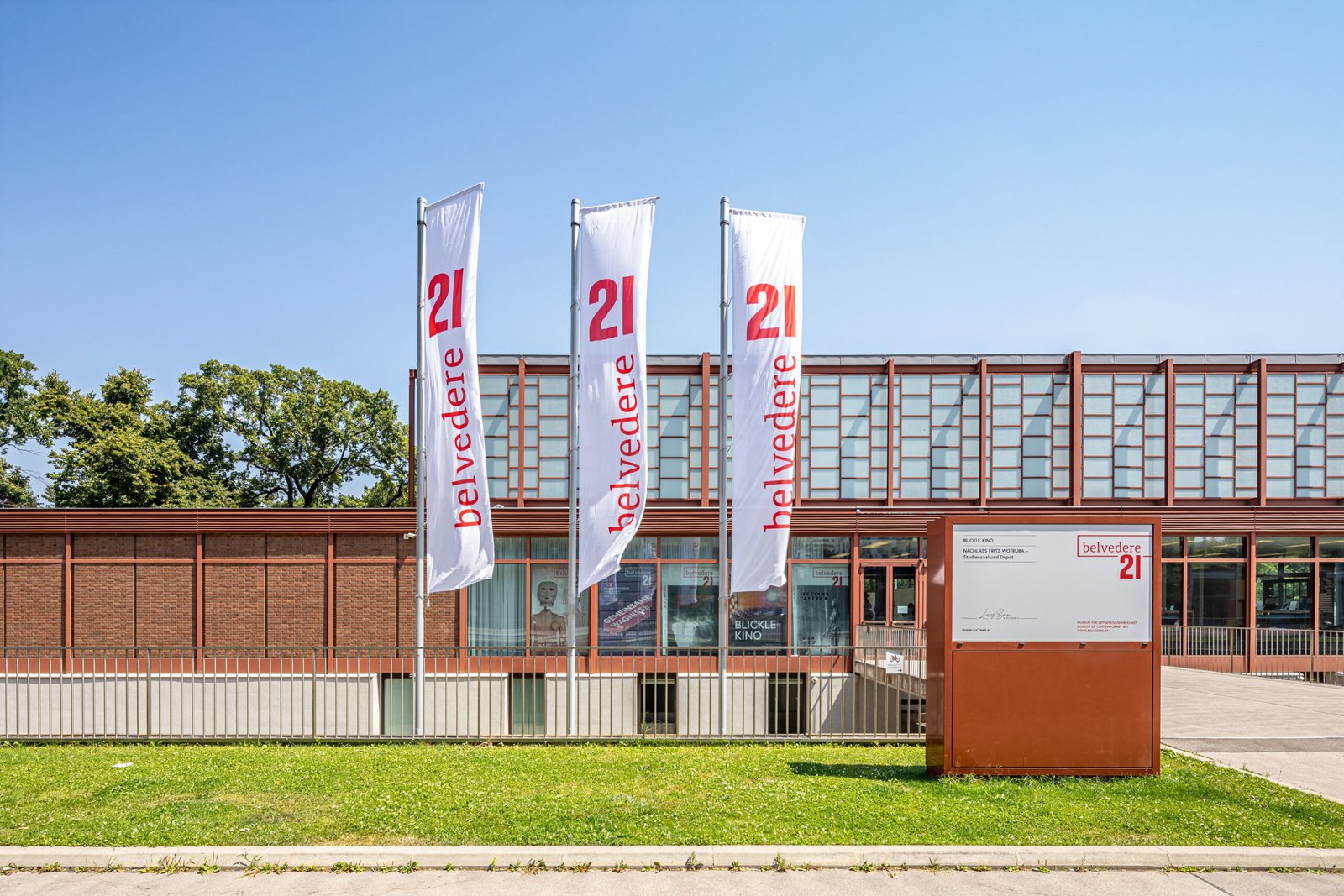
The exhibition Feminist Futures Forever at Belvedere 21 brings together 238 international artists from different generations to present a polyphonic panorama of feminist art from the historical feminist avant-garde through to possible futures.
Feminism concerns everyone, everywhere: at work, on the street, at home, in matters of reproduction, in the writing of history, and, not least, in art. Yet for all their diversity, feminists across different times and places share a commitment to critically examining existing inequalities and envisioning more just futures.
The exhibited artworks reflect the diversity of feminist ideas while demonstrating that there is neither a single feminism nor a uniform feminist aesthetic. This understanding already guided the legendary exhibition Kunst mit Eigen-Sinn (Art with a Mind of Its Own), initiated by VALIE EXPORT. With the support of Johanna Dohnal, then Austria’s State Secretary for General Women’s Issues, an international exhibition by and with women was presented in 1985 at the Museum of the 20th Century—now Belvedere 21—for the first time in an Austrian federal museum.
Kunst mit Eigen-Sinn was groundbreaking for feminist art production and also marked an important new beginning in terms of its institutional anchoring. In close collaboration with filmmaker and artist Christiana Perschon, an Oral Herstory project documents the personal memories and experiences of artists who participated in Kunst mit Eigen-Sinn in 1985 and are also represented in Feminist Futures Forever.
In the spirit of a new beginning, Feminist Futures Forever opens with a section on the theme of birth. The title “Push It!” was inspired by the ideas of political philosopher Hannah Arendt, according to whom every birth brings with it the capacity for revolution. The exhibition’s title is at once a promise and a call to action: The futures will have been shaped by feminisms. It recalls how feminist movements have transformed existing structures and affirms that the pursuit of equality and participation remains unfinished. The narratives unfold across nine sections: Alongside the aforementioned “Birth: Push It!”, the sections are “Smoking and Rebellion: Little Fires Everywhere,” “Public Space: Take Back the Streets!,” “Work: She Works Hard for the Money,” “Bedroom: Because the Night,” “Bathroom: Cold, Clear Water,” “Transition: I Stand on the Line,” “TV Room: Moving Image as a Feminist Space,” and “Archive: Found & Lost.”
Against the backdrop of a global resurgence of right-wing, authoritarian and misogynist forces, the exhibition underscores the renewed urgency of feminist perspectives. Gender equality remains unrealized, and the struggle to overcome patriarchy continues through protest, resistance and the imagining of more equitable futures. This understanding of feminism as an ongoing process of change also informs the exhibition architecture developed by Dorit Margreiter Choy and Cosma Grosser. Committed to the spirit of queer-feminist spatial production, they conceive of both the building and the institution as dynamic structures, while a sculptural scaffolding intervention underscores the process of transformation.