
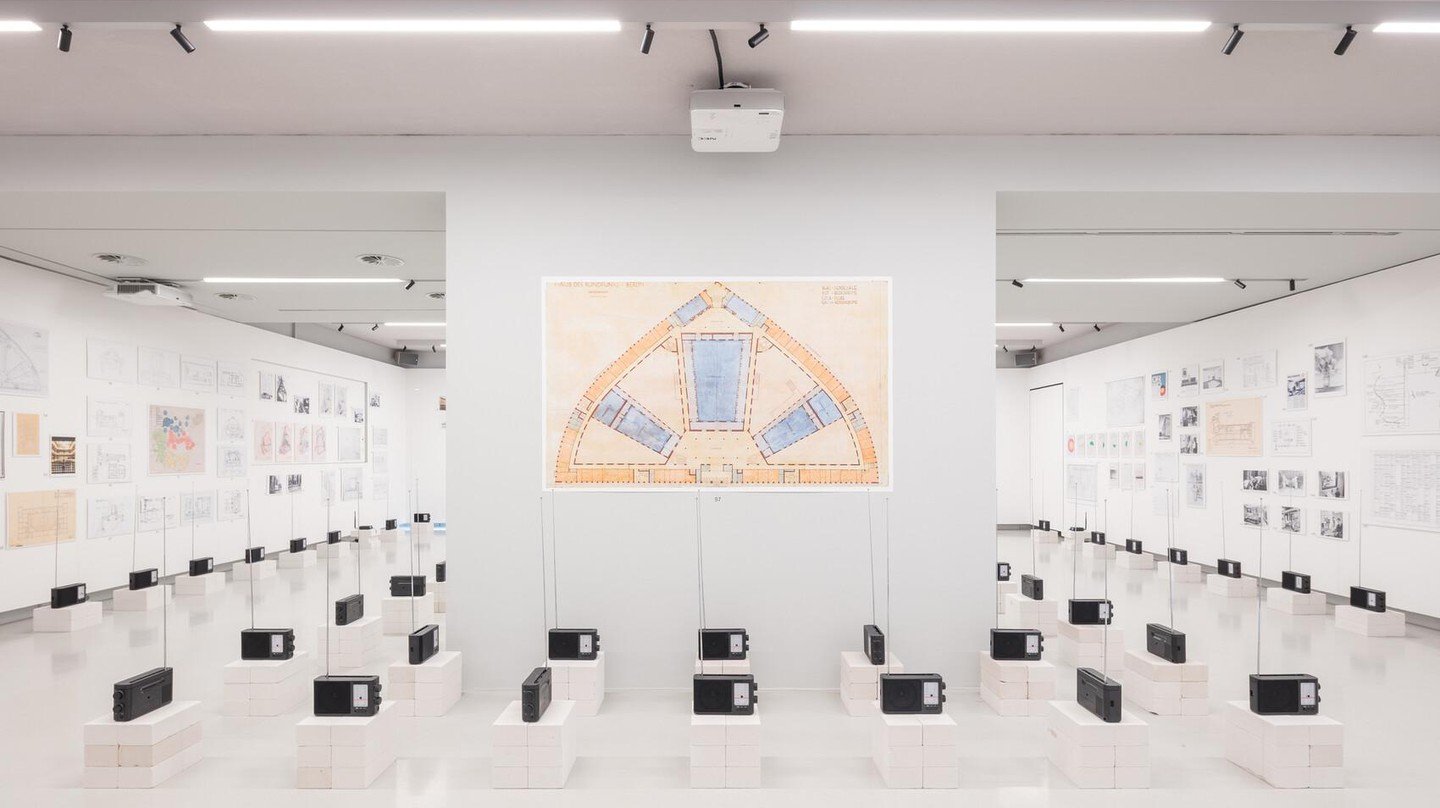
The exhibition Radio-Activities showcases the built infrastructure for radio in Berlin, from the Weimar Republic to the Cold War era. Through the presentation of sounds, archival drawings, and cartographic representations, it offers a unique perspective on the interplay between politics, electronic media, and architecture. Thiermann’s book of the same name, published by MIT Press, makes its debut at the vernissage.
The research spans from the Weimar Republic to the Cold War, focusing on Berlin’s radio infrastructure. 60 years after the Berlin Wall’s construction, the exhibition re-examines the coexistence of opposing political and aesthetic worldviews within the city. It highlights how radio waves crossed the Iron Curtain and the Berlin Wall, using different architectural means to conquer, protect, and compete over fluctuating borders. “Radio-Activities” reveals the material aspects of seemingly invisible infrastructures, questioning the stability of buildings and walls in the context of technology, politics, and mass media, and examining their relevance in our hyper-connected world.
Alfredo Thiermann is an architect and professor of the history and theory of architecture at the École polytechnique fédérale in Lausanne. He explores the intersection between architecture and media, focusing on the relationship between the environment, politics, and information technologies. Alfredo Thiermann is a Rome Prize winner for the 2022/23 cohort. The exhibition is part of the festival “Summer of the Arts—Villa Massimo Guests in Stuttgart.”
This exhibition is part of: Summer of Arts. Villa Massimo visits Stuttgart: 18 artists, eight institutions. July 18–July 22, 2024.